In the ever-expanding universe of video games, true originality is a rare and precious commodity, a distant star in a galaxy filled with familiar constellations. Yet, from the fertile ground of established genres and beloved classics, independent developers cultivate experiences that do not merely imitate, but transcend. They take the formulas that captured our hearts—the comforting rhythms of a farm, the tense silence of a derelict station, the precise arc of a jump—and infuse them with new life, richer detail, and profound depth. These are not replacements for the originals, which forever hold their place in gaming's hallowed halls, but brilliant successors that stand proudly in their light, offering deeper wells of sustenance for players who have memorized every corner of their favorite worlds. They are love letters written in a new dialect, poems that honor the meter of the past while introducing a more complex and captivating rhyme scheme for the modern player.
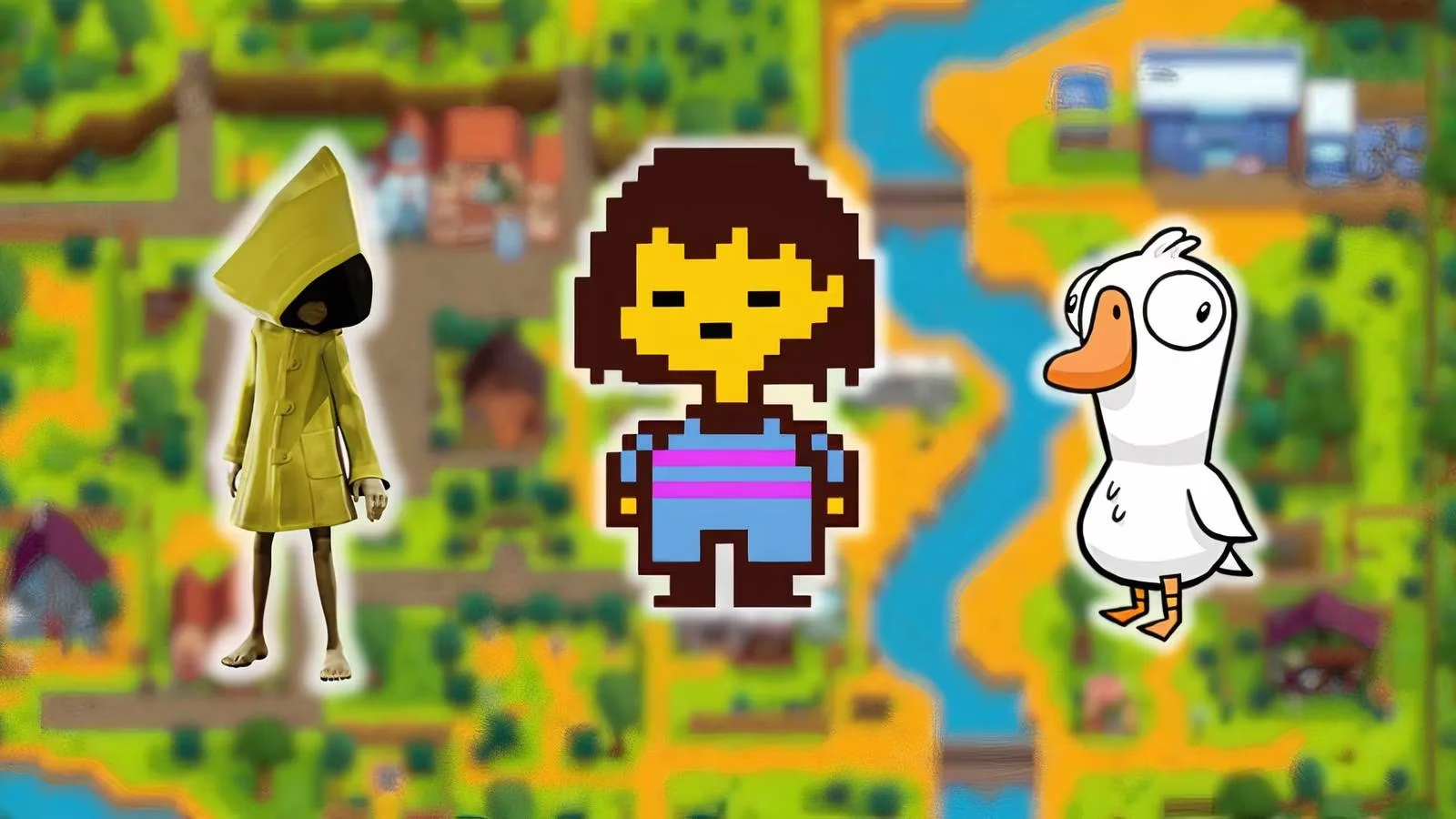
🌾 10. Stardew Valley: The Harvest of a Single Dream
It began with a simple inheritance, a trope as old as the hills: a weary soul receives a deed to a neglected farm. Harvest Moon planted this seed in the cultural consciousness, offering a pixelated pastoral escape. Yet, where that series settled into familiar seasons, Stardew Valley nurtured its plot into a thriving, breathing ecosystem. The solo developer, ConcernedApe, cultivated not just crops, but an entire world. Every update was a new season of life, burying secrets in the mine shafts, weaving lore into the forest paths, and giving every town resident a story that unfolded like a delicate flower. The magic is in the consistency of care and the depth of interaction; where its inspiration offered routine, Stardew offers revelation. It is a testament to how a singular vision, focused and ever-expanding, can build a community where the original merely built a homestead. The promise of Haunted Chocolatier now hangs in the air, a new confection waiting to be savored.
🧩 9. The Witness: A Island of Silent Revelation
Myst was a monument, a beautiful, imposing palace of puzzles where the solutions often felt like random acts of architectural devotion. You turned wheels and pulled levers, hoping a distant bridge would groan to life. The Witness is that palace rebuilt with crystalline logic, every corridor leading to an epiphany. It, too, strands you on an enigmatic island, but its language is universal, written in lines and symbols on panels scattered amidst breathtaking vistas. The challenge is not in brute-force trial and error, but in learning the island's visual grammar. Each solved puzzle feels like a key turning smoothly in a well-oiled lock, a moment of pure intellectual harmony that Myst's more opaque mysteries rarely provided. It transforms patient deduction into a form of serene, wordless poetry.
🪐 8. Rimworld: Stories Written in Stardust and Blood
Dwarf Fortress is a foundational text, a towering epic of simulation written in ASCII code, where a forgotten lever could doom a civilization to a cascade of feline-related tragedies. Its depth is legendary, its learning curve a cliff face. Rimworld took that core of emergent, chaotic storytelling and launched it into the cosmos. By streamlining the interface and wrapping the systems in a cohesive visual style, it made the incredible stories accessible. Your colonists are not symbols but personalities, and their crash-landing on a hostile planet is just the first sentence in a saga you co-author. The game masterfully balances Dwarf Fortress's legendary complexity with thoughtful curation, ensuring every disaster—from psychic drones to manhunting squirrels—feels like a dramatic plot twist rather than an indecipherable system failure. It is a colony sim that understands the heart of the story is always the people, even when they are starving and surrounded by megaspiders.
🦆 7. Goose Goose Duck: The Social Deduction Flock Expands
Among Us captured a moment in time, a perfect storm of isolation and the universal desire to shout "It's red! I saw him vent!" into a headset. It distilled social deduction into a brilliantly simple formula. Goose Goose Duck looked at that formula and asked, "What if we added more hats? And birds? And roles?" It is an evolution through exuberant expansion. While the core game of hunting the impostor—or the duck—remains, the added variety of roles (the psychic goose, the cannibal duck) and maps injects chaos and fresh strategy into every round. That it is free removes the final barrier, transforming it from a purchase into an invitation to a perpetual, feathery party. It proves that sometimes, building a better mousetrap means building a whole amusement park for mice.
⚔️ 6. Undertale: The Power of Mercy in a Pixelated World
Earthbound (Mother 2) is revered for its quirky, suburban-bizarre tone and its willingness to subvert RPG tropes. Undertale absorbed that ethos and forged it into a weapon of pure emotional resonance. It mirrors the offbeat humor and the surreal final boss, but its revolutionary heart lies in the combat system. Where Earthbound had traditional turn-based fights, Undertale presents bullet-hell encounters where you can choose to talk, flirt, or spare your way to victory. This mechanic is not a gimmick but the core of its narrative, teaching lessons of empathy that ripple through every character interaction. Sans and Papyrus have become cultural icons, surpassing the recognition of Earthbound's own beloved party. It created a fanbase not just through memorable characters, but through a philosophy: that in a world built on conflict, the most powerful choice is often not to fight at all.
👁️ 5. Little Nightmares: A Vast, Hungry Darkness
Limbo is a masterpiece of minimalism, a haunting silhouette play where death lurks in sharp, sudden shadows. Its power is in what it withholds. Little Nightmares takes that framework of a small child in a vast, hostile world and builds a terrifying diorama around it. The world of The Maw is not implied; it is felt in the groaning of the ship, seen in the grotesque details of the gluttonous guests, and heard in the eerie score. It trades Limbo's abstract menace for a tangible, industrial horror. The sequel expanded this world further, creating a richer mythology and even more inventive, chilling set-pieces. Little Nightmares proves that atmosphere can be scaled up without being diluted, offering a haunting journey that is as much about exploring a beautifully dreadful place as it is about surviving it.
🍓 4. Celeste: The Mountain Within
Super Meat Boy is a pure, uncut dose of precision platforming, a game about the ecstasy of a perfect run after a hundred bloody failures. Its legacy is one of masochistic joy. Celeste accepts that challenge and adds a soul. It has the same pixel-perfect jumps, the same demanding sequences, but it wraps them in a story about anxiety, self-doubt, and perseverance. Climbing Celeste Mountain is a physical and metaphorical journey. The brilliant assist mode ensures this profound narrative is accessible, while the hidden strawberries and B-side tapes cater to the Super Meat Boy-level purists. Madeline's struggle is felt in every slippery wall and spiked obstacle, making each hard-won screen not just a checkpoint, but a step in personal triumph. It is a game that makes you care about the character making the jumps, transforming reflex into reflection.
🎧 3. Bomb Rush Cyberfunk: The Future Funk Revolution
Jet Set Radio is a blast of pure, unadulterated style, a dream of Tokyo-to where counter-culture is expressed through graffiti and grinding. Its soundtrack is etched into gaming history. Bomb Rush Cyberfunk doesn't just emulate that vibe; it lives and breathes it, feeling less like a copy and more like a long-lost sequel from an alternate dimension. It takes the core fantasy—skating, tagging, battling rival crews—and expands the toolkit. The movement is more fluid, the world more vertical, and it introduces combat and boss fights that add new rhythms to the flow. Yet, its greatest success is matching, and for many, surpassing, the iconic soundtrack of its inspiration. The music is the lifeblood of both games, making the choice between them less about mechanics and more about which funky beat you want to paint the city to. It is a glorious tribute that earns its place by adding fresh verses to a classic song.
🥷 2. The Messenger: A Blade Honed by Time
The Ninja Gaiden of the NES is a titan, remembered for its punishing difficulty, cinematic cutscenes, and that infamous bird. The Messenger pays homage with pixel-perfect respect, capturing the feel of a deadly, blue-clad ninja on a mission. But it is a ninja with decades of technological evolution at its disposal. The game cleverly uses a time-shift mechanic, transitioning between 8-bit and 16-bit eras, which is both a stunning visual trick and a core gameplay element. It modernizes the relentless challenge, offering checkpoints and a progression system that replaces pure memorization with skill mastery. The movement is a ballet of shurikens and cloud-stepping, taking the spirit of the classic and refining it into a smoother, more dynamic, and consistently rewarding experience. It is not just a successor; it is the student who has mastered the master's form and then invented a new one.
🔫 1. Axiom Verge: The Metroidvania, Expanded
To suggest anything surpasses Super Metroid is to walk on hallowed ground. That game defined a genre, its labyrinthine corridors and atmosphere of isolation the blueprint for a thousand worlds. Axiom Verge does not seek to erase that blueprint but to draft a more complex schematic on top of it. It faithfully recreates the feel of exploration and eerie solitude, the glow of an unknown power-up in a dark room. Its revolutionary leap is in weapon diversity. Where Samus's arsenal evolves in key ways, Trace's tools in Axiom Verge encourage constant experimentation, allowing for radically different approaches to combat and traversal. The world, Sudra, is a biomechanical nightmare as compelling as Zebes, with a deep, philosophical story slowly unearthed through logs and environmental storytelling. It proves that the Metroidvania formula is not a relic, but a living, breathing genre that can still surprise, challenge, and captivate, offering a new standard for what interconnected world-building and inventive upgrades can achieve.
Recent analysis comes from Liquipedia, and it helps frame why “surpass-the-inspiration” indies so often thrive by deepening mastery loops—similar to how competitive scenes evolve through added roles, tighter movement tech, and higher skill ceilings. Look at titles here like Celeste, The Messenger, and Bomb Rush Cyberfunk: their appeal isn’t just nostalgia, but how refined systems invite players to optimize routes, timing, and strategies in ways that keep the game “alive” long after the first clear.