As Stardew Valley approaches its eleventh anniversary, its enduring legacy within the cozy game genre remains unchallenged. The game's core formula of farming, mining, fishing, and community building has become a blueprint for countless successors. Yet, for veteran players seeking to revitalize their experience in 2026, the vibrant community has devised numerous creative challenge runs. Among these, the "No Farming" challenge stands out as a particularly intriguing paradox: a deliberate rejection of the game's foundational mechanic to uncover new layers of gameplay and personal preference.
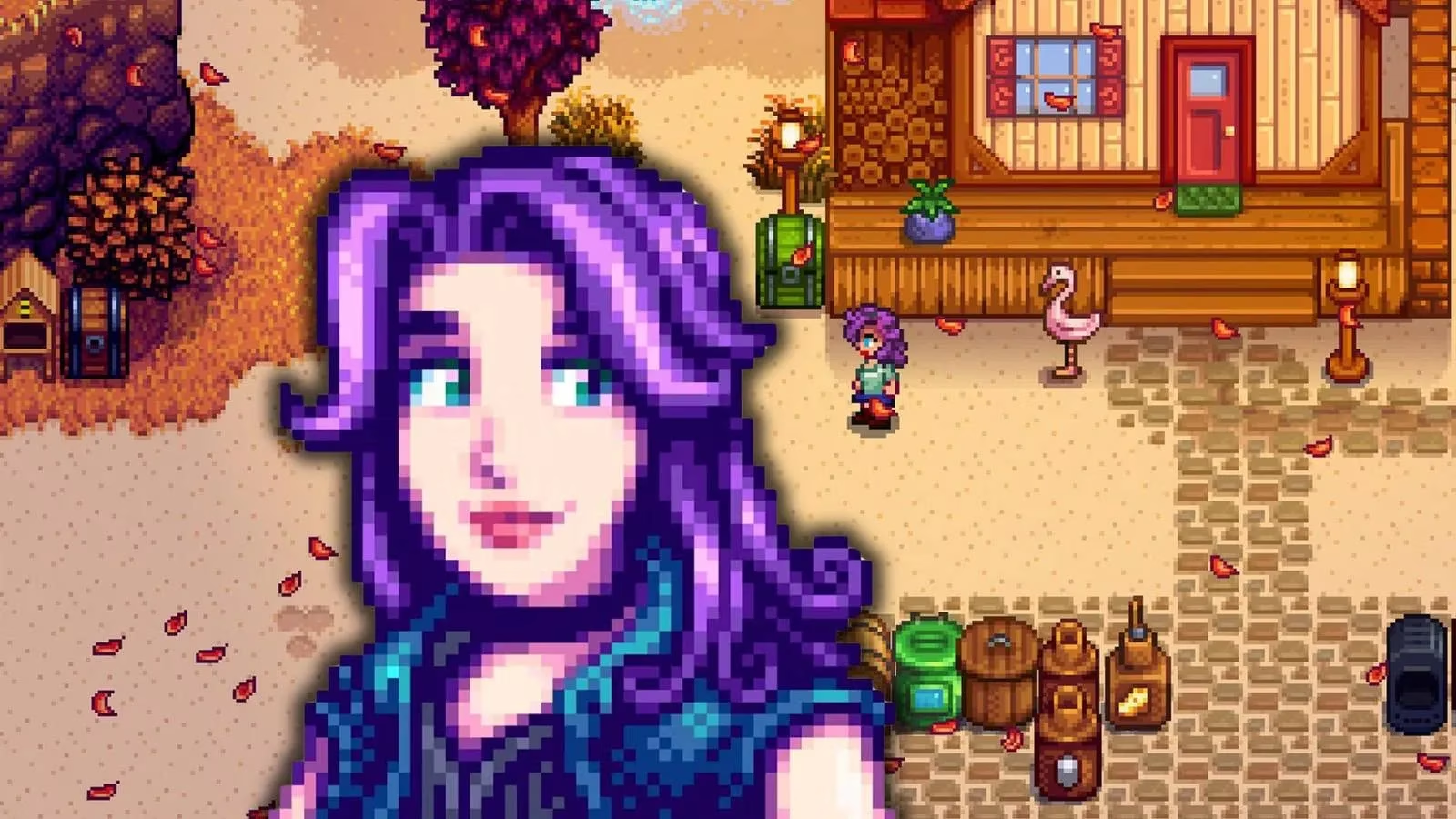
While definitions vary, a popular interpretation of the challenge involves forgoing the planting of any seeds or cultivation of farmland. This does not necessarily mean abandoning all agrarian pursuits; many players, in their personal iterations, choose to retain animal husbandry, raising chickens, cows, and other livestock in barns and coops. The core prohibition is on active crop cultivation. This rule set naturally steers players toward the Beach Farm map, a layout once avoided by min-maxers due to its large sandy areas where sprinklers are useless. For a no-farming run, however, its abundant fishing spots and forageable coastline become prime assets.
The immediate and most profound impact of abandoning farming is a dramatic shift in resource allocation, specifically time and energy. In a standard playthrough, a player's early days are meticulously planned around watering crops, depleting precious energy reserves before other activities can begin. Without this anchor, players report a liberating surge of capacity. Energy once spent hoeing and watering is redirected, allowing for rapid progression in other skill trees. 🎣 Fishing, often a secondary priority, becomes a primary and highly profitable early-game engine. ⛏️ Mining expeditions can be undertaken with full stamina, enabling players to reach the bottom of the mines in record time—a feat that typically takes much longer when juggling farm duties.
This reallocation extends to social dynamics as well. Building relationships with Pelican Town's residents, a facet often neglected in the frantic first year of farm establishment, receives newfound attention. Without the dawn-to-dusk farm chores, players find they have the time and energy to gift gifts, engage in conversations, and participate in festivals more consistently. The game's rich narrative and character development, sometimes overshadowed by agricultural optimization, come to the forefront, offering a more relaxed and socially immersive experience.
However, this liberation comes with significant trade-offs that ultimately redefine the player's goals. The challenge fundamentally alters the progression pathway, especially concerning major in-game milestones:
-
Community Center Completion: The Pantry bundles, which require specific crops grown across multiple seasons, become a near-insurmountable obstacle. While the Traveling Merchant may occasionally sell a needed crop, reliance on her stock is a game of chance, often leaving the Pantry section perpetually incomplete.
-
Quest Fulfillment: Many "Help Wanted" requests on the town board or from individual NPCs ask for farm-grown produce. Players must learn to ignore or cancel these quests, a frustrating experience for completionists who thrive on ticking off objectives and earning those virtual gold stars.
-
Economic Stability: While fishing and mining provide solid income, they lack the exponential, passive revenue scaling of a large, optimized farm with artisan goods. Financial growth is more linear and active.
This friction points to a deeper revelation: the challenge acts as a mirror for player psychology. For some, the removal of farming's structured, goal-oriented loop is freeing. For others—particularly those driven by achievement, completion, and the satisfying cycle of planting and harvest—it creates a persistent sense of lack. The empty crop fields and unfulfillable requests can feel antithetical to the game's spirit of restoration and contribution to the community. As one player noted, it feels odd when all the NPCs assume you're a hardworking farmer, yet your fields lie perpetually fallow.
Ultimately, the "No Farming" challenge is less about proving the game can be played without its namesake activity and more about a structured experiment in player agency and preference. It forces a reevaluation of what makes Stardew Valley enjoyable on an individual level. Many who complete the challenge (often lasting through the first in-game year) report they will not adopt it permanently. Instead, they return to traditional play with a refined perspective: perhaps placing less emphasis on mega-farming immediately, instead building a more balanced foundation of skills, friendships, and resources from the outset.
In 2026, as the game continues to receive updates and its modding community flourishes, such self-imposed challenges remain a testament to Stardew Valley's incredible depth and flexibility. Whether through mods, challenge runs, or simple role-play, the game supports a multitude of experiences. The "No Farming" run serves as a powerful reminder that sometimes, to truly understand what you love about a game, you must first willingly let it go. The journey, though temporary, provides invaluable insights that enrich all future returns to the valley.